
Mangrove Conservation at Pandiyar Estuary
Restoring mangroves on the Kanniyakumari coast to protect coastal communities and sustain fisheries.
- Conservation
- Kanniyakumari coast
- Estuary restoration
- 40 ha to be restored
Why mangroves, why here
After the tsunami in Tamil Nadu, frequent forceful intrusion and withdrawal of sea water has deeply affected coastal communities. That has created needs for disaster preparedness and risk management, for livelihoods, and for conservation work.
Mangrove trees act as the saviour of the coastal ecosystem against intense tidal waves. They grow luxuriantly in inter-tidal regions along estuaries, backwaters, islands and other protected areas.
That valuable cover has been deforested so heavily that the ecosystem along the west coast of India is degraded. This has affected the coastline and, to a large extent, fisheries.
- Programme area
- Conservation
- Scope
- Kanniyakumari coast · estuary restoration
- Location
- Pandiyar river estuary, Rajakkamangalam Panchayat, Kanyakumari district
- Implemented by
- SEEDS Trust
The target area
Nearly 1,000 hectares of estuarine environment in Kanyakumari district are identified as a potential zone of fishery resource.
- ~1,000 haestuarine environment with fishery potential
- 200 haalong the Pandiyar estuary and coast
- 40 hato be restored with mangroves
- 1,400 mmannual rainfall
The Pandiyar river estuary and coastline, including households in Rajakkamangalam Panchayat on the Arabian Sea and the edge of the Gulf of Mannar (about 8°03′–8°35′ N, 77°05′–77°36′ E), extend to about 200 hectares and hold a prime position.
What mangroves need to grow
Mangrove species tolerate different levels of salinity. How far a mangrove forest can spread depends on these four factors.
What we do
SEEDS Trust has started projects to conserve the Rajakkamangalam estuary, for biodiversity and for the livelihoods of the people who depend on it.
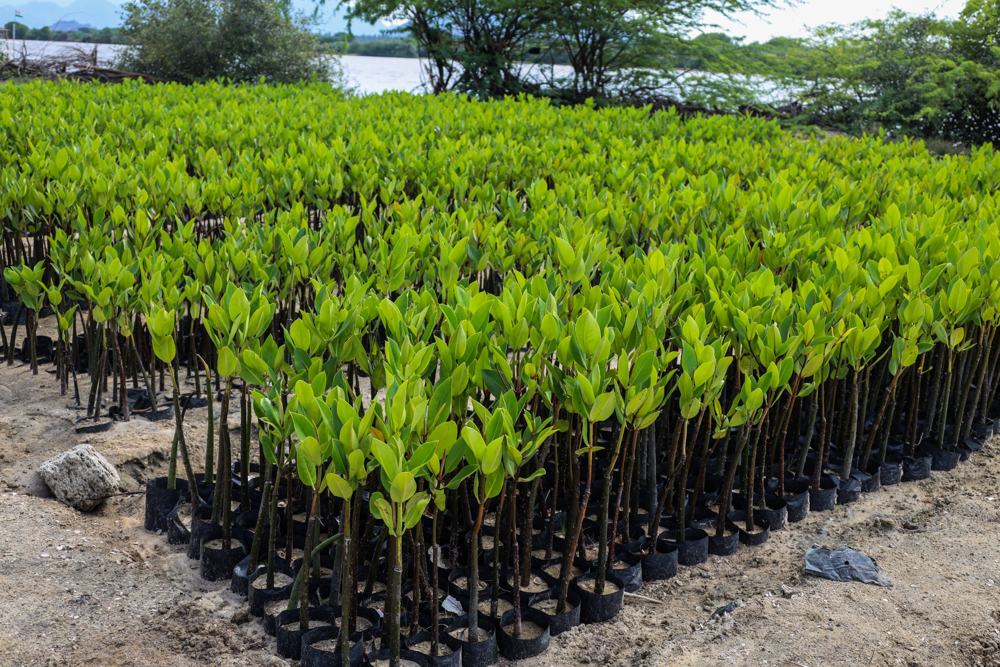
- Restore and regenerate mangrove vegetation on 40 hectares of the 200 identified along the Pandiyar river estuary in Rajakkamangalam.
- Promote planting of mangroves and associated species that give cyclone protection, habitat for small mammals, birds and marine life, and income for communities who depend on small fishing.
- Sensitise coastal communities to the importance of the estuary and of their own role and responsibility in protecting coastal ecosystems.
- Build a model in coastal biodiversity conservation that can be expanded to all estuaries along the Tamil Nadu coast.
Benefits to communities and nature
Cyclone protection
A natural shield against intense tidal waves and storms.
Habitat
Home for small mammals, birds and marine life in the estuary.
Income
Support for communities who depend on small fishing.
Awareness
Communities learn why the estuary matters and how to protect it.
Across all of our work, 250 hectares of mangroves have been rejuvenated. Alongside the restoration, beekeeping for fisherwomen in 10 villages of the Pandiyar estuary adds a livelihood that depends on healthy mangroves.
More in Conservation
Tamil Nadu Biodiversity Conservation and Greening Project
Dindigul & Karur · 412 villages · JICA
Support this workAll programmesNext: Tamil Nadu Biodiversity Conservation and Greening Project